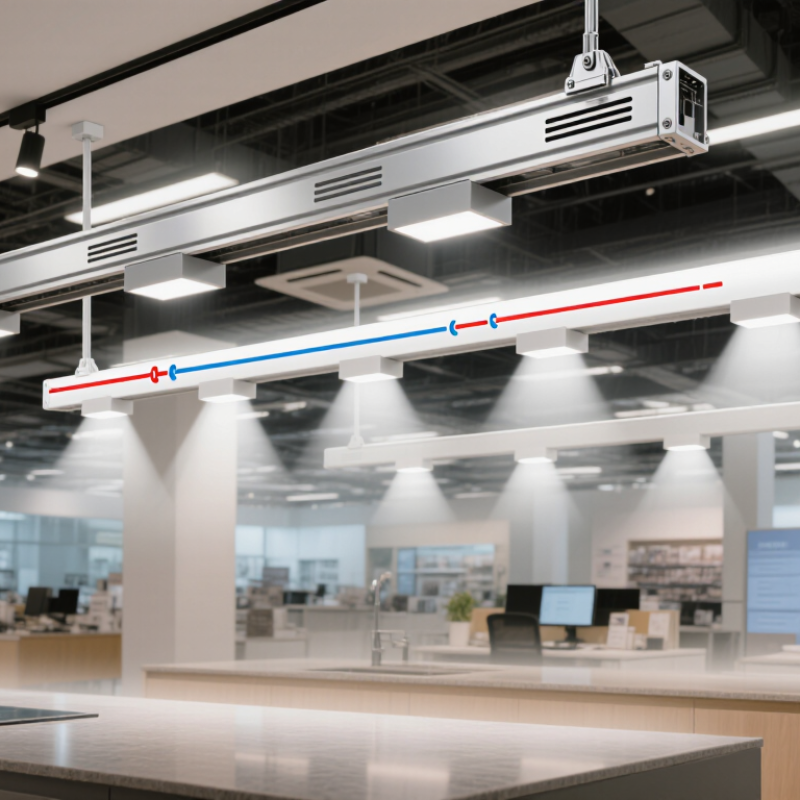
Are aluminum power tracks better than plastic ones? The answer depends on heat, load, installation quality, and long-term expectations. Aluminum usually offers stronger mechanical support and better heat dissipation. Plastic can remain lighter, cheaper, and easier to handle. That difference becomes visible above a kitchen island, where several luminaires run for hours each evening.
Lighting consultant David Warfel has expressed a practical principle: “The best lighting system is the one that serves the space, not the product.” That idea matters here. An aluminum power track may resist bending beside a busy retail display. It may also feel more stable when fixtures are moved repeatedly. Yet plastic is not automatically inferior. Good engineering, insulation, and certified components can make plastic systems safe and reliable in suitable environments.
The details matter more than the material label. Check conductor design, connector quality, current rating, grounding, and heat exposure. A track installed near a hot ceiling or crowded with adapters needs careful evaluation. Aluminum can conduct heat away, but it also requires proper insulation and bonding. Plastic can reduce accidental contact risks, but low-quality plastic may become brittle over time.
There is no universal winner. That is the uncomfortable part. Some comparisons focus only on price or appearance. They miss installation errors, maintenance access, and future compatibility. This China Top 10 review examines those practical differences closely, while recognizing one limitation: product performance can vary significantly between manufacturers, even within the same material category.
China Top 10 Aluminum Power Tracks Better Than Plastic?
What Aluminum Power Tracks Are and How They Work
An aluminum power track is a slim electrical rail that distributes power along a ceiling or wall. Inside, insulated conductors carry electricity to several connection points. Track adapters lock into these points and supply individual lights or equipment. Moving a fixture usually requires no new cable route. That flexibility suits galleries, shops, offices, and changing display areas.
The aluminum shell provides mechanical strength and helps release heat from the track assembly. It is not automatically better than plastic. Many systems still use copper conductors, plastic insulation, and separate grounding parts. The material choices inside matter as much as the visible housing. A well-designed track should show clear ratings for voltage, current, temperature, and maximum connected load.
Installation details decide real performance. An electrician should check the circuit capacity, mounting surface, connector fit, and grounding path. A loose adapter may create resistance, heat, or flickering. A crowded track can also exceed its rated load. That limitation deserves attention. In a practical room test, a longer rail may need more support points to prevent slight bending. Local electrical codes and tested safety standards must guide the final selection. Cost comparisons can be misleading when installation time, replacement access, and future layout changes are ignored.
China’s modern factories need compact power distribution with high current capacity and easier installation. Aluminum power tracks meet this demand with a useful weight advantage. Aluminum has a density of about 2.70 g/cm³, compared with copper’s 8.96 g/cm³, according to the International Aluminium Institute. Lighter conductors reduce lifting effort and support faster ceiling installation. Plastic remains valuable for insulation and protection, but it cannot replace the conductor itself.
Thermal performance matters. Aluminum conducts roughly 61% as well as copper by volume, based on International Annealed Copper Standard data. Engineers therefore select larger cross-sections and carefully designed joints. IEC 61439 also requires verified temperature-rise, short-circuit, and mechanical performance for low-voltage assemblies. Small errors matter. Loose connections can create hot spots, especially in dusty workshops with continuous loads.
The sustainability case is practical, not perfect. The International Aluminium Institute reports that recycled aluminum requires about 5% of the energy used for primary production. This supports circular manufacturing when collection systems work properly. Yet aluminum expands more with heat than copper, and joint oxidation needs control. That means installation quality decides much of the final result. Plastic systems may suit light-duty circuits, but high-density facilities often need aluminum’s strength, serviceability, and lower handling weight. The choice still deserves calculation, not fashion.
China’s aluminum power-track sector combines large-scale manufacturing with increasingly strict quality controls. The USGS Mineral Commodity Summaries 2024 estimated China’s primary aluminum output at about 41 million metric tons in 2023. This supply base supports stable profiles, custom lengths, and faster tooling development.
A practical Top 10 shortlist includes single-circuit, three-circuit, recessed, surface-mounted, suspended, trimless, magnetic, curved, waterproof, and smart-control aluminum tracks made in China. Each type serves a different installation condition. Recessed tracks suit clean ceilings, while suspended systems help illuminate retail islands. Waterproof designs require careful sealing, not just thicker metal. IEC 61534 compliance, conductor spacing, load testing, and temperature control deserve closer attention than appearance alone. Check the factory’s inspection records.
The International Aluminium Institute reports that recycled aluminum can require about 95% less energy than primary aluminum. This supports lower-impact production, but recycled content must be verified through traceable documentation. The IEA also identifies aluminum as a significant industrial electricity user, making process efficiency important. In practice, I would compare wall thickness, connector heat rise, grounding quality, and repeated installation performance. A bright finish can hide weak spring contacts. That is easy to miss. The ranking is not absolute, because a premium recessed track may perform poorly in a humid commercial space. Independent testing, batch samples, and clear warranty terms remain essential when selecting among China-made aluminum power tracks.
China’s top 10 aluminum power tracks are often compared with plastic systems, but material alone does not decide performance. Aluminum usually offers stronger mechanical support, better heat dissipation, and improved resistance to impact. In a busy workshop, its rigid housing can protect internal conductors from accidental knocks. Plastic remains useful because it is lightweight, electrically insulating, and often easier to cut or handle during installation. However, low-quality plastic may become brittle under ultraviolet exposure or repeated heating.
Safety depends on design and installation. Aluminum must have reliable insulation, grounding, and secure joints because the metal itself conducts electricity. Plastic does not remove risk; heat, overloaded circuits, loose terminals, and poor sealing still create hazards. A track carrying power tools should be checked for temperature rise after continuous use. A warm surface may be normal. A hot connector deserves attention. Durability also depends on the environment. Aluminum can resist corrosion, but salty air and trapped moisture may still cause surface damage. Plastic can resist some chemicals, yet it may crack under impact or shrink with age. Neither option is perfect.
Tips: Match the track’s rated load with the real equipment load. Inspect joints, covers, and mounting points regularly. Choose UV-stable plastic for bright outdoor areas, and use treated aluminum near moisture. Ask for test reports, installation guidance, and clear maintenance records. A cheaper system may perform well, but assuming it will always do so is a mistake.
| No. & Evaluation Dimension | Aluminum Power Track | Plastic Power Track | Practical Interpretation |
|---|---|---|---|
| 1. Electrical Conductivity |
Advantage Aluminum is an electrical conductor, with a resistivity of approximately 0.028 µΩ·m at 20°C. It can serve as a current-carrying conductor when properly insulated and engineered. |
Insulating Advantage Common engineering plastics are electrical insulators, with volume resistivity commonly above 1012 Ω·cm, depending on grade, moisture, and additives. |
Aluminum supports integrated conductive rails, while plastic is better suited for non-conductive housings, covers, and touch-protection components. |
| 2. Current-Carrying Capacity |
Generally Better Aluminum conductors can carry substantial current when cross-section, temperature rise, contact resistance, and ventilation are correctly designed. |
Indirect Function Plastic itself does not carry current. Its role is usually structural or protective; current capacity depends on the internal metal conductors. |
For modular power tracks, the conductor design matters more than the outer housing. Aluminum is relevant when the rail itself is conductive. |
| 3. Heat Dissipation |
Strong Advantage Aluminum has a typical thermal conductivity of about 150–235 W/m·K, allowing heat to spread away from conductive parts. |
Low Conductivity Many common plastics have thermal conductivity of approximately 0.1–0.4 W/m·K, so heat is retained more easily. |
Aluminum can help control temperature rise, although insulation, airflow, conductor size, and connection quality remain essential. |
| 4. Mechanical Strength and Rigidity |
Generally Better Typical aluminum alloys have an elastic modulus near 69 GPa and provide high rigidity at relatively low weight. |
Grade Dependent Unreinforced engineering plastics commonly have an elastic modulus of roughly 1.5–4 GPa; reinforced grades can be considerably higher. |
Aluminum is usually preferable for long spans, repeated accessory installation, and assemblies requiring dimensional stability. |
| 5. Impact and Scratch Resistance |
Good, With Finish Aluminum resists cracking and remains structurally stable, but its surface can dent or scratch without anodizing, coating, or other protection. |
Variable Some impact-modified plastics resist shock well, while other grades may crack, become brittle, or show permanent deformation under impact. |
Plastic may absorb impact more quietly, but aluminum generally provides more consistent long-term structural protection. |
| 6. Fire Performance and Smoke |
Strong Advantage Aluminum is non-combustible under ordinary building-fire conditions and does not contribute fuel like an organic polymer. |
Must Be Specified Plastic fire behavior varies by resin, additives, wall thickness, and test method. Some grades are flame-retardant, while others can ignite or produce smoke. |
Aluminum is often favored in fire-sensitive environments, but the complete power-track system must still meet the applicable fire and enclosure requirements. |
| 7. Temperature Resistance |
Generally Better Aluminum maintains useful structural performance across a broad temperature range; its melting point is approximately 660°C. |
Grade Dependent Continuous-use temperatures commonly range from about 70°C to 150°C, depending on the polymer and formulation. |
Aluminum is better for hot equipment areas, high-load operation, and applications with frequent thermal cycling. |
| 8. Dimensional Stability and Creep |
Strong Advantage Aluminum has low creep at normal indoor operating temperatures and retains its shape under sustained mechanical loading. |
More Sensitive Plastics can experience creep, shrinkage, or expansion under continuous load, elevated temperature, and humidity. |
Aluminum is usually more reliable for fixed rail alignment, repeated module changes, and installations requiring tight tolerances. |
| 9. Corrosion and Environmental Resistance |
Good With Protection Aluminum naturally forms a thin protective oxide layer. Salt, alkaline cleaners, galvanic contact, and harsh chemicals can still cause corrosion. |
Often Strong Many plastics resist moisture and common chemicals, but ultraviolet radiation, solvents, heat, and plastic aging can reduce service performance. |
Material selection should match the environment. Coatings, UV stabilization, seals, and compatible fasteners can significantly extend service life. |
| 10. Service Life, Maintenance, and Recyclability |
Long-Life Advantage Aluminum is durable, repairable in many designs, and widely recyclable without losing its basic material properties through repeated recycling. |
Design Dependent Plastic can be lightweight and economical, but mixed materials, additives, aging, and contamination can make recycling and end-of-life separation more difficult. |
Aluminum often offers stronger long-term durability and recycling value, while plastic can reduce initial weight and cost when performance demands are moderate. |
| Data note: Values are representative ranges for commonly used aluminum alloys and engineering plastics, not specifications for a particular product. Actual performance depends on conductor cross-section, insulation system, enclosure design, electrical load, ambient temperature, installation method, and compliance with applicable standards such as IEC, UL, or equivalent national requirements. | |||
Aluminum power tracks can offer better rigidity, heat control, and long-term stability than many plastic systems. They also create a cleaner appearance in offices, kitchens, and retail displays. However, aluminum is not automatically the better choice. Plastic tracks may weigh less, cost less, and provide useful insulation in low-load applications. The right option depends on your environment, electrical load, installation method, and maintenance plans.
Check the track’s rated current, voltage, socket spacing, and connector compatibility before buying. Measure the wall or ceiling area carefully. A few millimeters can affect the final fit. For humid rooms, inspect the enclosure and corrosion resistance. In high-use areas, choose a strong aluminum profile with secure internal contacts. Always follow local electrical requirements and use a qualified electrician for fixed wiring.
Tips: Match the track to your real load, not your future guess. Leave room for expansion, but avoid oversized products. Examine the contact design, insulation, and fastening parts. Ask for test reports and installation instructions from the supplier. A polished finish can hide weak construction, so look inside the system. I have seen attractive tracks fail because the connectors were poorly aligned. Appearance matters, but reliable contact matters more.
It is a slim electrical rail mounted on a ceiling or wall. Insulated conductors distribute power through multiple connection points. Track adapters connect individual lights or equipment. Fixtures can move without installing new cable routes.
Aluminum provides mechanical strength and helps release heat. However, it is not automatically better than plastic. Copper conductors, insulation, and grounding parts remain important. The visible shell does not tell the whole story.
They suit galleries, shops, offices, and changing display areas. Recessed tracks create cleaner ceiling lines. Suspended systems can illuminate retail islands. Surface-mounted models simplify installation.
Check voltage, current, temperature, and maximum connected load ratings. Also review conductor spacing and grounding information. A crowded track can exceed its rated capacity. That limitation matters.
Yes, a loose adapter can increase electrical resistance. It may create heat, flickering, or unreliable lighting. Check the connector fit before repeated use. Small faults can grow.
Often, yes. A longer rail may bend slightly without enough mounting points. The mounting surface also affects stability. Support spacing should follow the installation instructions and site conditions.
They can be suitable when sealing, ratings, and installation are properly verified. A thicker aluminum shell alone does not provide waterproof protection. Inspect seals, connectors, and cable entry points carefully. Waterproof claims need evidence.
Compare wall thickness, connector heat rise, grounding quality, and repeated installation performance. Request batch samples and inspection records. Clear warranty terms are useful. I would not rank products by appearance alone. Bright finishes can hide weak spring contacts.
This guide explores what aluminum power tracks are, how their conductive components and modular outlets work, and why they are increasingly used in modern Chinese electrical systems. Aluminum offers a practical balance of light weight, strength, heat resistance, and design flexibility, making it suitable for homes, offices, retail spaces, and industrial environments. The article introduces ten notable types of aluminum power tracks made in China, covering different layouts, installation methods, lengths, outlet configurations, and application needs without focusing on specific brands.
It also asks, “are aluminum power tracks better than plastic ones?” The answer depends on the project. Aluminum generally provides greater durability, improved heat dissipation, stronger structural support, and a more refined appearance, while plastic may be lighter, less expensive, and suitable for simpler installations. The comparison considers performance, safety, service life, maintenance, and installation convenience. Finally, readers will learn how to select the right track by evaluating electrical capacity, safety features, mounting method, environment, customization options, and long-term value.

Ranko Power